Most businesses wait for customers to reach out. The ones with better retention don’t.
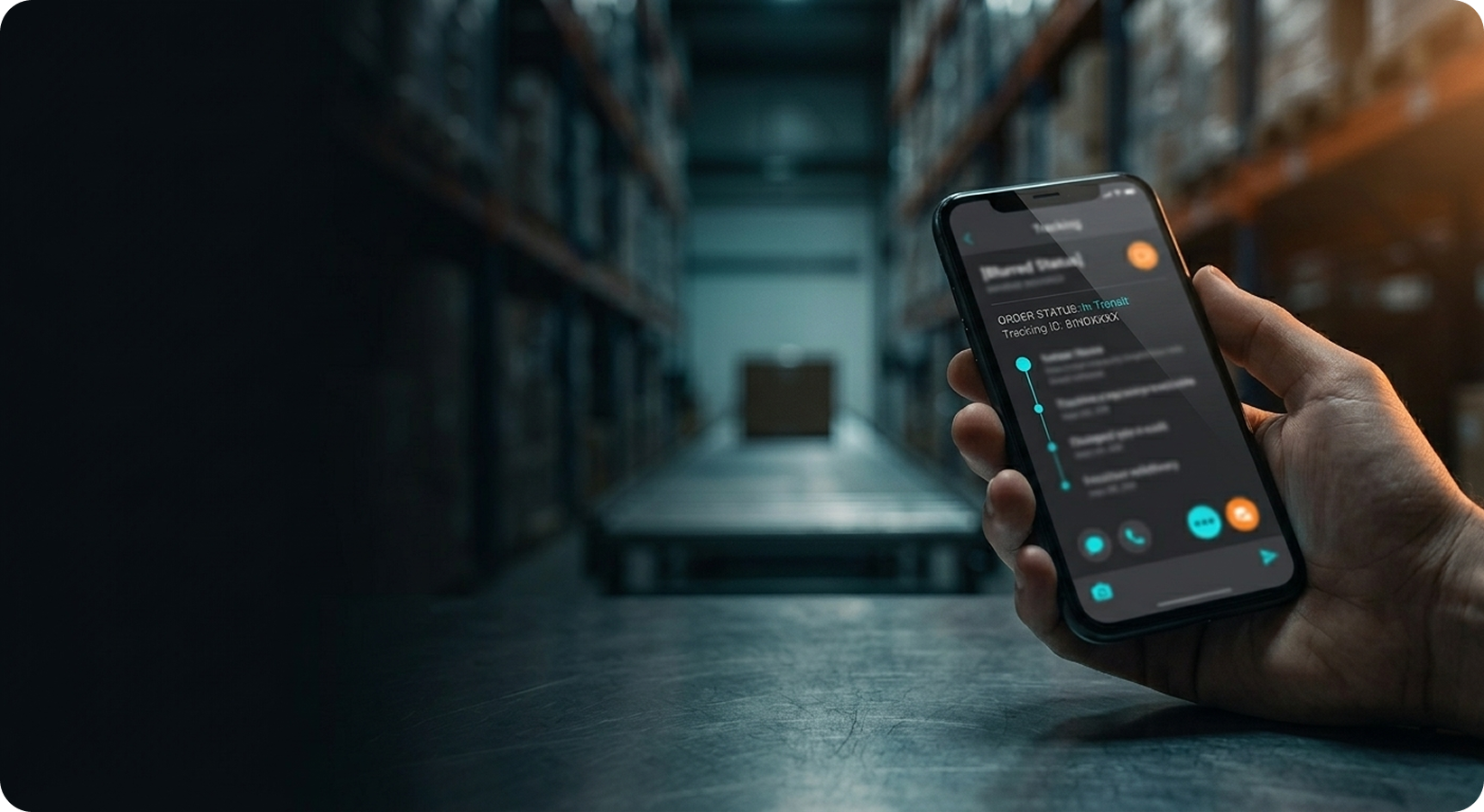
Here’s a situation most businesses recognise. A customer buys something. You get their money. They get… silence. Maybe a confirmation email. Then nothing for two days. So they check their inbox. Check the website. Eventually send a message: “Just wondering what’s happening with my order.”
That message cost you money. It also cost them patience they didn’t need to spend.
Automated customer communication fixes this. Not by replacing your support team, but by handling the part that shouldn’t require a human in the first place — the predictable, time-sensitive updates that customers need and businesses already have.
This piece covers what automated customer communication actually means in practice, which channels do what, and what the data says about the businesses that have got it right.
Why Customers Contact You (And Why Most of It Is Preventable)
Support teams have a quiet problem. A large share of their daily volume — incoming messages, emails, calls — is about things the business already knows the answer to. Order shipped. Payment received. Appointment confirmed. The information exists. It just never reached the customer.
The consequence is predictable. According to Verint, in 2024, 61% of customers said they prefer contacting brands via digital channels — up from 45% in 2023. Digital contact volumes are growing fast, and customer expectations are rising alongside them. According to HubSpot’s 2024 State of Customer Service, 75% of customer service reps reported the highest-ever ticket volume that year.
And when the response isn’t fast enough? According to Zendesk’s 2026 data, 85% of CX leaders say customers will leave a brand after just one unresolved issue.
Most of those contacts are not complex. They’re information gaps. And information gaps are exactly what automated customer communication is built to close.
Proactive vs. Reactive: What the Gap Actually Costs
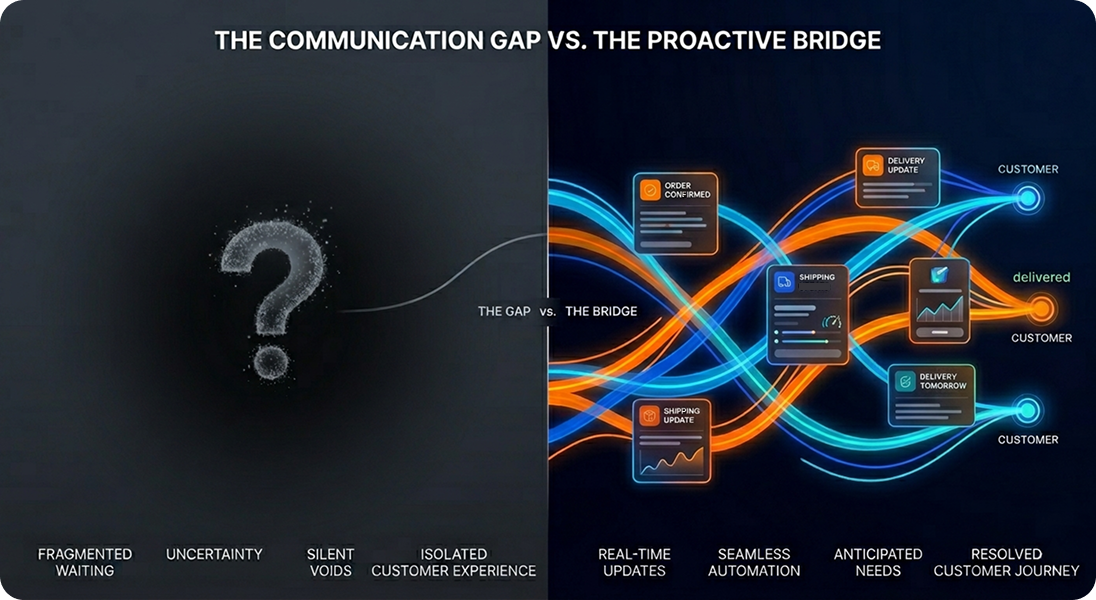
Reactive communication is the default. The customer notices something, reaches out, and you respond. It works, technically. But it’s slow, expensive, and it puts the customer in the position of chasing you.
But proactive automated communication inverts that. You send the update before customers ask. You flag the issue before they find it themselves. According to Screendesk, proactive communication reduces support ticket volume by 20-30% during high-incident periods. And according to McKinsey, proactive customer service can reduce contact centre call volume by 20-30%, cutting operational costs by up to 25%.
Because here’s what customers actually respond to: not perfection, but transparency. A delayed shipment handled with immediate, clear communication is forgiven far more often than one that goes quiet. The problem is rarely the problem. The silence is.
According to HubSpot, 77% of support agents say their workload increased over the past year. A significant chunk of that is avoidable. It’s the predictable questions that never would’ve been sent if the customer had been told first.
The numbers behind automated customer communication
| Metric | Finding |
| Customers preferring digital contact (2024) | 61% — up from 45% in 2023 |
| Customer retention: strong omnichannel vs. weak | 89% vs. 33% |
| Satisfaction uplift from proactive omnichannel comms | Up to +33% |
| Reduction in contact centre calls from proactive comms | 20-30% — McKinsey |
| Customers who leave after one unresolved issue | 85% according to CX leaders |
| Common service issues AI will resolve autonomously by 2029 | 80% — Gartner, 2025 |
| Customers expecting faster response than 5 years ago | 65% |
Sources: Verint/Nextiva (2024), Forrester/Aberdeen Group, McKinsey, Zendesk (2025), Gartner (2025)
Automated Customer Communication by Channel: What Each One Does
Automated messaging only works if it reaches people. That means meeting customers on the channels they already use. According to Salesforce, customers now use an average of nine different channels when engaging with a single company. You don’t need to be on all nine. But a single-channel approach leaves obvious gaps.
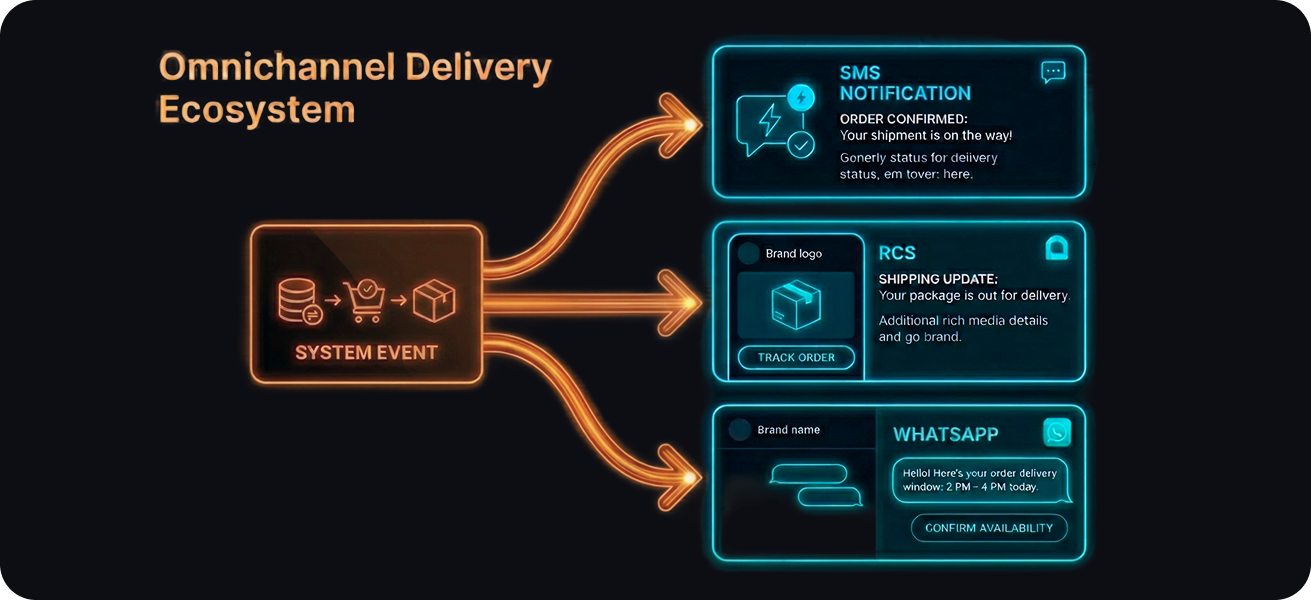
Here’s how the main three channels fit into an automated communication setup:
SMS: The reliability baseline
SMS has a ~98% open rate and most messages are read within minutes. No app required, no login, no algorithm between you and the customer. It works on every mobile device, everywhere.
For time-sensitive automated notifications — delivery windows, payment confirmations, appointment reminders, fraud alerts — SMS is the most dependable channel available. It’s the foundation any automated setup should build on first.
RCS: Smarter automated notifications
RCS (Rich Communication Services) delivers to the native messaging app on Android and iOS, but adds branded sender profiles, verified identity, interactive buttons, carousels, and read receipts. Customers know it’s actually you.
For post-purchase communication, this makes a real difference. A branded notification with your logo, a live tracking button, and a one-tap option to reschedule delivery is a different experience from a plain-text message. According to industry data, RCS had an estimated 2.5 billion monthly active users globally as of 2024, a figure that has continued to climb following Apple’s iOS 18 integration. Engagement rates run consistently above 70% — with click-throughs up to 7x higher than SMS.
RCS also handles two-way interaction natively. A customer can confirm, reschedule, or flag an issue from within the same thread — without calling, emailing, or opening a separate app.
WhatsApp: Automated messaging with conversational depth
WhatsApp has nearly 3 billion monthly active users worldwide. In most markets outside North America, it’s simply where people communicate. The Business Platform lets companies send templated automated notifications — order updates, confirmations, payment alerts — and then handle follow-up within a 24-hour service window.
The practical advantage is richness. WhatsApp supports photo proof of delivery, location sharing, voice messages, and quick-reply buttons. For logistics, retail, and financial services, those capabilities open up formats that SMS and email can’t match.
And because customers already live in WhatsApp, the engagement barrier is low. The automated message lands in the same app they use to talk to their friends.
What Good Automated Customer Communication Looks Like in Practice
The most common starting point is transactional messaging: order confirmed, shipped, delivered. These are the right place to begin because the trigger is unambiguous (something happened in your system) and the customer expectation is clear (tell me about it).
But the businesses getting the most from customer communication automation go further. They automate exception handling — when something goes wrong, the customer finds out from you before they discover it themselves. They automate re-engagement — a well-timed message to a lapsed customer based on real behavioural signals. They automate post-interaction feedback — a short survey sent at exactly the right moment after a resolved issue.
According to Customer Contact Week, customers who are told about a problem proactively are significantly more forgiving than customers who discover it on their own. Because the issue is rarely the issue. It’s the feeling that nobody was paying attention.
Across industries, the omnichannel retention numbers tell the same story. According to Forrester / Aberdeen Group, companies with strong omnichannel engagement strategies retain 89% of their customers, compared to 33% for those without. That’s not a marginal difference. It’s a different business.
Building Your Automated Communication Setup: Where to Start
For most businesses, the right starting point is simple: one trigger, one message, one channel.
Find the communication gap that causes the most pain — the question customers ask most often, the silence that lasts longest. Build an automated message for that moment. Measure the impact on inbound contact volume. Then add the next one.
Once SMS notifications are running, RCS is the natural upgrade — devices that don’t support it automatically fall back to SMS, so there’s no reach penalty. WhatsApp layers in where your customer base is already there and where you want genuine two-way capability.
The goal isn’t a sophisticated system on day one. It’s to close the most obvious gap first. A business sending three well-timed automated messages — order confirmed, shipped, delivered — is already ahead of most of its competitors. And the compounding effect of fewer routine contacts frees up the capacity to handle everything else better.
Three Ways Automated Customer Communication Goes Wrong
It’s worth knowing the failure modes before you build.
The most common is over-messaging. Customers who receive too many notifications — especially ones that don’t add new information — start ignoring all of them, or opt out entirely. Every automated message should pass a straightforward test: does this tell the customer something they need to know, at the moment they need to know it? If not, it shouldn’t send.
The second is channel mismatch. Not every update belongs in WhatsApp. Not every alert should be an SMS. Matching the nature and urgency of the message to the right channel is part of the design work, not an afterthought.
And the third is treating automation as a substitute for human support rather than a complement to it. According to Gartner, by 2029, agentic AI will autonomously resolve 80% of common service issues, with a 30% reduction in operational costs. But that future depends on the handoff working. Automation handles the predictable. When someone needs a person, the route to one has to be obvious and fast.
The Bottom Line on Automated Customer Communication
Automated customer communication is not a technology project. It’s a decision about how much of your customers’ patience you’re willing to spend.
Businesses that communicate proactively — that send the update before the customer asks, that flag the delay before it becomes a complaint — build more trust, carry fewer support tickets, and retain customers at significantly higher rates. The research has been consistent on this for years.
SMS, RCS, and WhatsApp each solve a different piece of the problem. They work better together than apart. And the barrier to getting started is lower than most businesses assume.
Because the customers who get the right message at exactly the right moment don’t think much about it. It just works. And businesses that make things just work tend to be the ones customers stick with.