Executive Summary As we enter 2026, the “Attention Economy” is being replaced by the “Trust Economy.” With SMS phishing (smishing) on the rise, customers are increasingly defensive, viewing unverified texts as security risks rather than engagement opportunities. This guide explores why legacy SMS is failing modern retail and how Rich Communication Services (RCS) offers a solution through Verified Identity. We outline how upgrading to secure, branded messaging not only eliminates fraud anxiety but unlocks new revenue through interactive, in-chat experiences.
Introduction: The Death of the “Open Rate”
For the last fifteen years, retail marketing has been focused on chasing a single metric: Attention.
The playbook was simple. If you could ping a phone, trigger a vibration, and get eyeballs on a screen for a few seconds? That was it, you won. It didn’t matter if the message came from a random short code, a filtered email address, or a browser notification. If the customer looked, your job was done.
But as we settle into 2026, we see the Attention Economy collapsing. It is being replaced by something far more fragile and far more difficult to measure: the Trust Economy.
Here’s the reality facing digital transformation leads today: Your customers aren’t just distracted; they’re defensive. They’re being bombarded daily, getting hit with salvos of digital fraud so intensely that it’s turned the simple act of clicking a link into an anxiety-inducing endeavor..
When 76% of consumers say they would not buy from a company who they do not trust with their data, “security” becomes a marketing metric. If your customer hesitates to click your delivery update because they’re scared it could be a phishing scam? Then you haven’t just lost a click; you’ve lost brand equity.
This shift has created a paradox for modern enterprise. On the one hand, you’re under pressure to be more personal and pervasive than ever. But at the same time, your customers are building up defensive walls on a solid foundation of skepticism.
We’ll explore why the salad days of SMS are over, why Rich Communication Services (RCS) has emerged as the only viable successor for enterprise retail, and how verified identity effectively future-proofs your customer experience against the rising tide of fraud.
The “Smishing” Pandemic: How SMS Failed the Modern Retailer
SMS (Short Message Service) is over 30 years old. It was built for a world where we trusted the phone network implicitly. It was never designed for high-value ecommerce; it never foresaw a world like that. And it certainly wasn’t designed for a world of automated cybercrime.
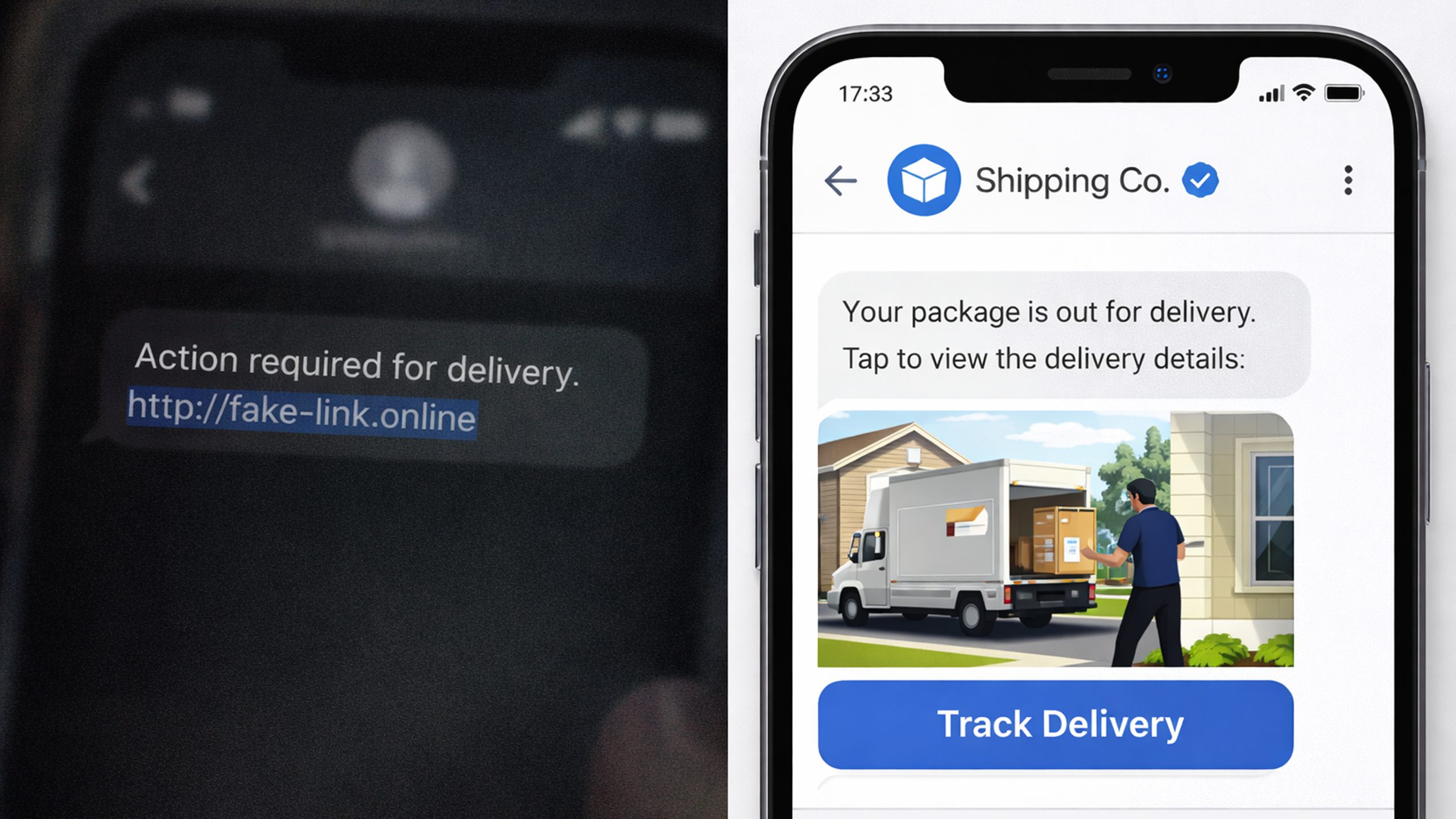
In the last 24 months, we have witnessed the industrialization of “Smishing” (SMS Phishing). And attacks specifically impersonating logistics and delivery services. The classic “Your package is delayed, click here” scam—have become the dominant form of mobile fraud.
This has created a modern phenomenon called “Delivery Anxiety.”
To understand it, consider the psychology of your customer’s journey:
- The Purchase: They buy a high-value item (e.g., a designer handbag) from your ecommerce site.
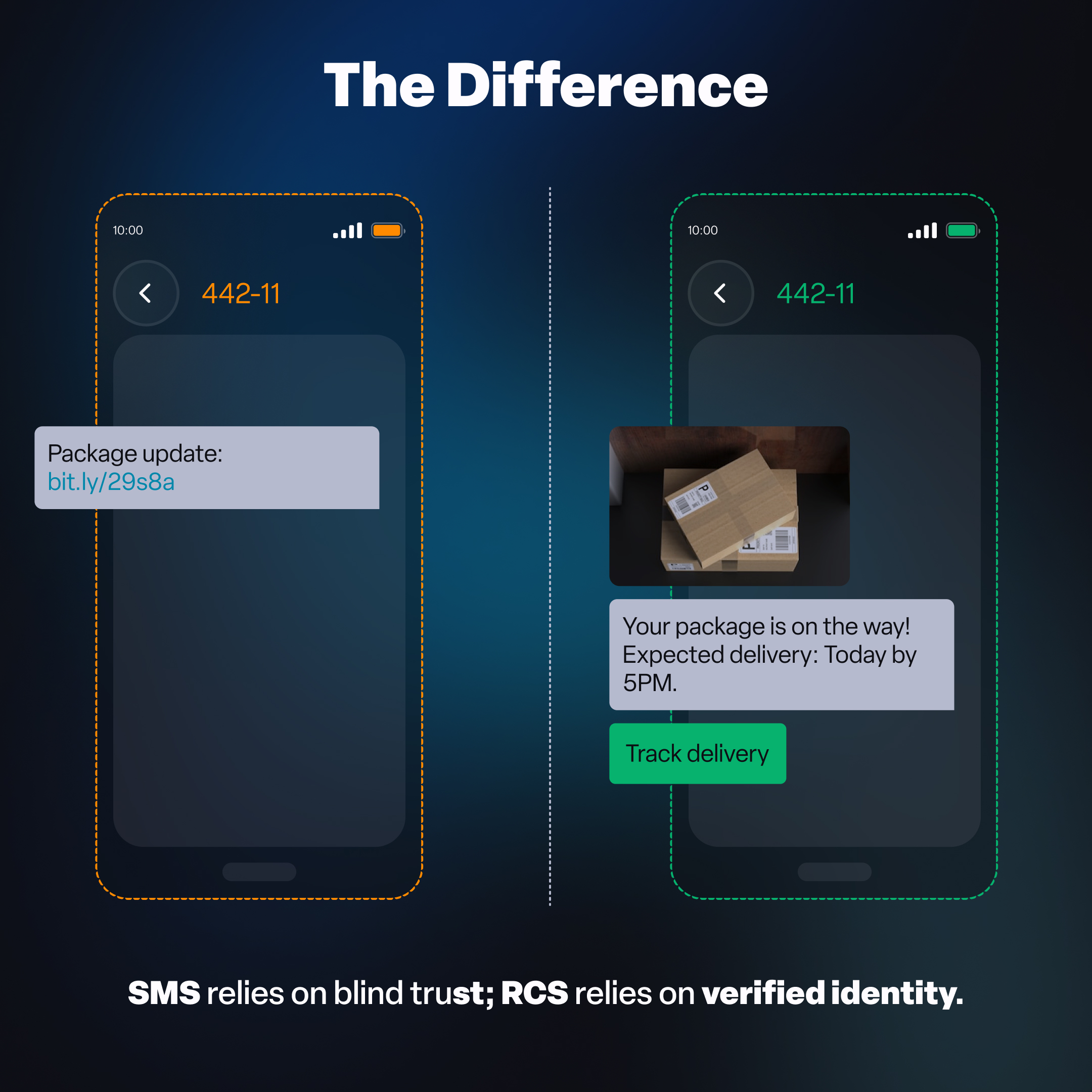
- The Notification: Two days later, they receive a text from a random short code like “44-221.” The text reads: “Order #8821 update: Please confirm address details. bit.ly/29s8a.”
- The Friction: The customer freezes. Is this really you? Or is this a scammer who bought a list of numbers on the dark web?
That split-second pause creates unnecessary friction where conversions die. SMS has entered a zero-trust environment. The legitimate channels you rely on for transactional updates are now obscured in the fog of fraud. Relying on SMS for critical communications is no longer a low-cost strategy; it’s becoming a high-risk liability.
RCS Verified Identity: The New Digital Storefront
This is where Rich Communication Services (RCS) stops being just “an upgrade to SMS” and starts being a strategic asset for risk management and customer experience (CX).
RCS is often described as “iMessage for Android” (and iOS 18+). But that comparison misses the point for businesses. For enterprises, the true value of RCS lies in Verified Identity.
Unlike SMS, where anyone with a budget can rent a number, RCS operates on a “Verified Sender” protocol. When you message a customer via RCS, three specific authentication layers fundamentally alter the user experience (UX):
1. The Verified Badge
Every message you send to customers arrives with a checkmark badge. This isn’t a graphic you can upload; it’s a certification authenticated by the carrier and the aggregators. This makes it the digital equivalent of a uniformed employee your customers can talk to in-store. It signals: “This channel is authorized.”
2. Brand Immutability
Instead of a random number like “+49 (123) 456-7890,” the sender ID is your brand name. It cannot be spoofed. The header includes your logo and brand colors.
3. The “Clean” Interface
RCS removes the “link” anxiety. Instead of sending a raw https:// link that looks suspicious, RCS uses suggested action buttons and rich cards. The customer isn’t clicking a shady URL; they are tapping a button that says “Track Package” or “View Invoice” within the native UI of the phone.
The result of this psychological safety is tangible. According to Google, 72% of consumers are more likely to make a purchase online if they can ask questions in real-time through a verified channel. This lift isn’t because the offer is better; it’s because the fear factor friction has been eliminated.
RCS in Action: 3 Strategic Use Cases for Retail
For digital leads everywhere, the question isn’t “What can the tech do?” it’s “What strategic outcomes does the tech create?”
We have moved past the pilot phase of RCS. Leading global retailers are now using it to solve specific bottlenecks in the acquisition, support, and retention funnels.
Use Case 1: The “Virtual Personal Shopper” (Acquisition)
- The Challenge: Mobile conversion rates still lag behind desktop. Browsing a catalog on a 6-inch screen is tedious, and downloading a dedicated app for a single purchase adds unnecessary friction.
- The RCS Solution: Carousel Discovery.
- How It Works: A customer abandons a search for “hiking boots.” Instead of a generic “Come back!” message over SMS or email, you trigger an RCS message.
- The Message: “Still looking for hiking boots? Here are our top rated pairs for the season.”
- The Interaction: The user sees a swipeable carousel of high-res images directly in the chat. They can see the price, star rating, and available sizes without loading a web page.
- The Strategic Outcome: You have moved the “shopping aisle” into the conversation. Case studies have shown that this interactive approach can drive 10x engagement.
Use Case 2: Recovering Revenue from the Trust Gap (Conversion)
- The Problem: High cart abandonment rates at the payment stage. Baymard Institute data suggests nearly 20% of abandonment is due to “trusting the site with credit card info.”
- The RCS Solution: Secure Transactional Flows.
- How It Works: A user leaves items in the cart.
- The Message: A verified RCS message arrives with a photo of the item. “Your cart is reserved.”
- The Interaction: The message includes a “Complete Purchase” button.
- The Strategic Outcome: By wrapping the checkout nudge in a Verified Sender badge, you borrow the trust of the carrier. The user feels safer tapping “Pay” in a verified thread than clicking a link in an unverified text.
Use Case 3: The “No-Download” Returns Process (Retention)
- The Problem: The returns process is often the most friction-heavy part of the customer lifecycle. It usually requires logging in, finding order numbers, and printing labels. It’s a loyalty killer.
- The RCS Solution: Interactive Self-Service.
- How It Works: A customer wants to return an item.
- The Interaction: They text “Return” to your verified thread. An automated bot replies immediately: “Which item from your recent order?” and displays a carousel of their last purchase.
- The Resolution: The customer taps the item. The bot instantly generates a QR code in the chat. “Show this at the post office. No label needed.”
- The Strategic Outcome: You turn a negative experience (product return) into a “wow” moment of convenience, reducing call center volume and increasing Lifetime Value (LTV).
The Data Privacy Pivot: Zero-Party Data
We cannot discuss the 2026 landscape without addressing the data vacuum. With third-party cookies deprecated and privacy regulations (GDPR, CCPA) tightening, your ability to infer customer intent is vanishing.
You need Zero-Party Data, aka data the customer intentionally and proactively gives you.
And RCS is the ultimate engine for zero-party collection, because it feels like a conversation instead of a survey.
Consider a beauty retailer. Instead of tracking a user across the web to guess their skin type, they can use an RCS Welcome Flow:
- Brand: “Hi! To get your personalized recs, are you shopping for Dry, Oily, or Combo skin?”
- Customer: Taps “Combo.”
- Brand: “Got it. And do you prefer Retinol or Vitamin C?”
- Customer: Taps “Vitamin C.”
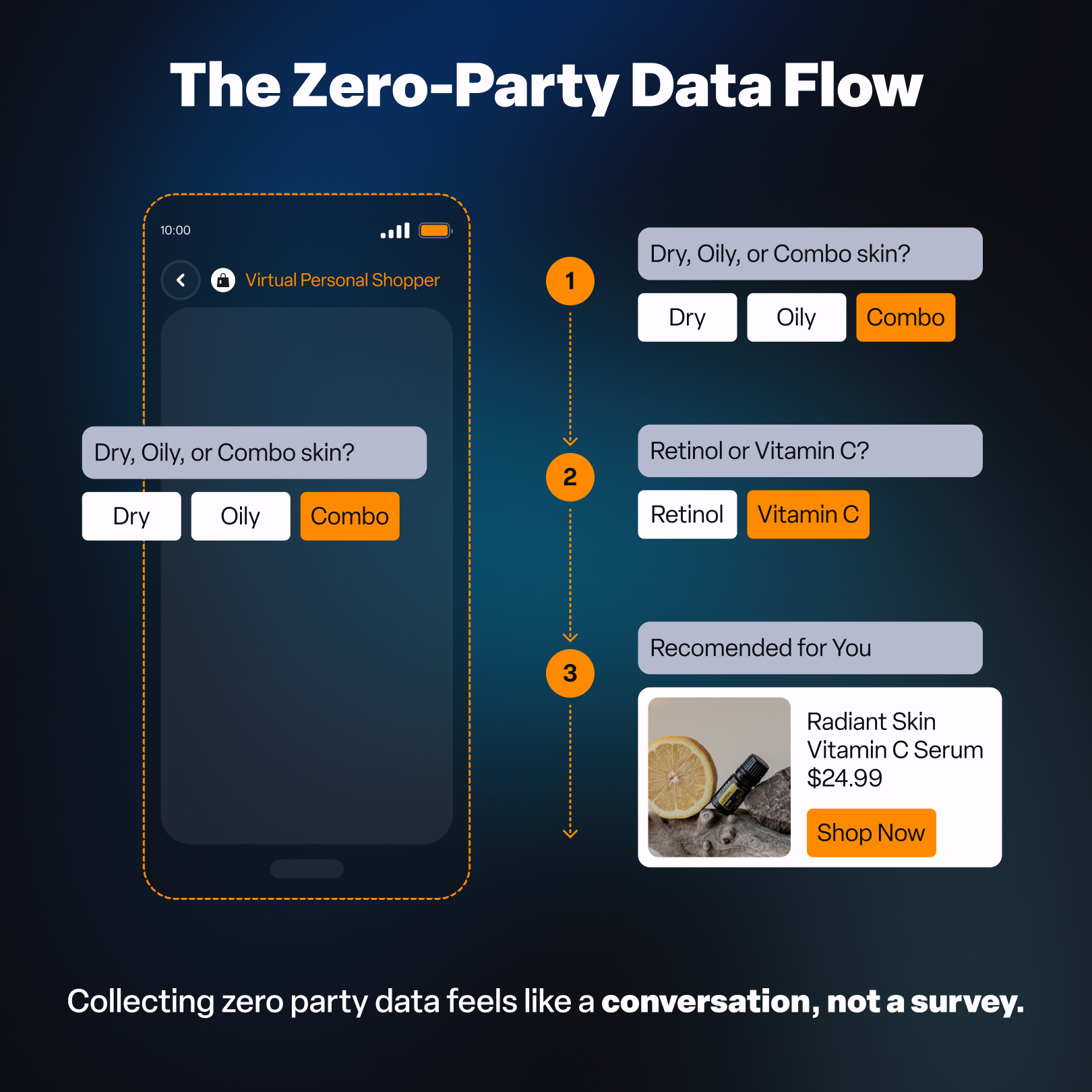
In two taps, you have segmented the customer with 100% accuracy and explicit consent. You didn’t infer this from a cookie; they told you. This data is gold. It allows you to personalize all future campaigns without crossing the “creepy” line, because the interaction happened in a transparent, two-way channel.
This is privacy by design. You aren’t scraping data; you are trading value (in this case, personalization) for information.
Conclusion: The Strategic Pivot
The shift to the trust economy is not a trend; it is a correction. The market is correcting for years of spam, fraud, and impersonal automation.
The brands that win in 2026 and beyond won’t be the ones with the loudest megaphones. They will be the ones that offer a sanctuary of reliability in the digital space. They will be:
- The brands whose messages are instantly recognizable and impossible to spoof.
- The brands that respect customer time by enabling transactions within the message.
- The brands that protect their customers from fraud by owning their identity.
For anyone in charge of digital transformation, this is your opportunity to realign marketing and security. You can move your organization away from the vanity metrics of “open rates” and toward the business metrics of “verified engagement.”
It is safer for your customers, it is smarter for your data strategy, and ultimately, it is the only way to do business in a world where trust is the scarcest resource of all.
If you are ready to map out what a secure messaging strategy looks like for your specific architecture—without the integration headache—let’s have a conversation. No fluff, just a plan to get you connected directly with your customers in an environment of high trust and low friction.
Frequently Asked Questions about RCS and Secure Messaging
Why is SMS considered high-risk for retailers now?
SMS lacks sender verification, which enables fraudsters to spoof brand numbers. This act is called smishing. Rampant smishing creates “delivery anxiety,” where customers hesitate to click legitimate transaction links for fear of phishing, lowering engagement and conversion rates.
What is the difference between SMS and RCS for business?
While SMS sends plain text from a phone number, RCS uses a “Verified Sender” protocol. This displays the brand’s verified name, logo, and a trust badge, and allows for secure features like interactive buttons instead of raw links.
How does RCS improve customer trust?
RCS helps improve trust with Verified Identity. Customers can instantly see that a message is from the official brand—and not a scammer—thanks to the carrier-authenticated checkmark and branded profile, significantly increasing their willingness to engage and purchase.
What is Zero-Party Data in the context of messaging?
Zero-Party Data is information a customer intentionally shares with a brand. RCS facilitates this by allowing brands to ask preference questions (e.g., “What size do you wear?”) via interactive buttons within the chat, collecting consent-based data without using tracking cookies.
Is RCS supported on iPhones?
Yes, as of iOS 18, Apple supports the RCS Universal Profile. This means brands can now deliver rich, verified, and secure messaging experiences to both Android and iOS users, with iOS coverage expanding daily.