

The Hidden Cost of “Good Enough”: Why Manual Returns Are Hurting Your Margins
It’s the dirty secret of Q1 retail. While your marketing teams celebrate the holiday revenue figures, your operations teams are quietly drowning in the “Great Return.”
For many eCommerce directors, the focus in early 2026 is on growth. But there is a leak in the bucket that no amount of new traffic can fix. It’s called retail margin leakage, and for most retailers, it is entirely self-inflicted.
We tend to look at the cost of manual returns in retail purely as a logistics expense: the price of the shipping label, the restocking fee, or the written-off inventory. But that calculation ignores the most expensive asset on your balance sheet: your team’s time.
If your current ecommerce returns best practices involve a customer support agent opening a ticket, then manually asking for an order number, then waiting for a photo of the damaged item, and only then logging into a separate portal to generate a label? You’re paying a luxury tax on every single return. And the luxury? It’s time.
This is the hidden cost of reverse logistics. It isn’t the shipping fee; it’s the friction.
We sometimes convince ourselves that our current email-based process is “good enough” because it doesn’t cost anything extra in software subscriptions. But “good enough” isn’t good enough when it’s actually a silent profit killer. As we look toward the efficiency trends defining 2026, the question isn’t whether you can afford to automate; it’s whether you can afford to keep paying humans to do robot work.
1. The 2026 Labor Reality: The “Luxury Tax” on Human Agents
Here’s the math that usually gets ignored. In the early 2020s, having a human handle a return was inefficient but affordable. But in 2026, it is financially irresponsible at best.
Following the inflationary shocks of the mid-decade, the labor market in Western Europe has stabilized at a structurally higher baseline. The days of cheap support labor? Those days are gone.
The “Fully Loaded” Cost
In primary markets like Germany, the average base salary for a Customer Service Agent now hovers between €41,500 and €44,000. However, the “fully loaded” cost to your business (including mandatory social security, health insurance, and the standard 13th-month salary) pushes the actual liability for a single agent above €54,000 annually.
In Belgium, automatic wage indexation has pushed costs even higher, while France remains a high-burden employer market.
The “Ping-Pong” Effect
A typical manual return workflow in 2026 remains painfully archaic for many mid-sized brands:
- Customer email: “I want to return this.”
- Agent reply (24h later): “Sure, what is the order number?”
- Customer reply: “Order #12345.”
- Agent action: Logs into ERP, checks eligibility, generates label, emails PDF.
This back-and-forth consumes approximately 20 minutes of active agent time per return.
If your team handles 1,000 returns a month, you are burning roughly 333 hours of labor. At a fully loaded cost of roughly €25-€30 per hour, you are spending €8,000 to €10,000 per month just on the administration of returns. And this does not include shipping, restocking, or lost inventory value.
In an era where “Customer Success” roles now command salaries of €74,000+ to drive retention, using these expensive human resources to print shipping labels is a misallocation of capital.
2. The Regulatory Sledgehammer: PPWR and the August 2026 Deadline
It isn’t just labor costs causing ecommerce to drown. The European Union’s new environmental regulations are the millstone dragging down ecommerce profitability, too.
The Packaging and Packaging Waste Regulation (PPWR) enters full force on August 12, 2026. This is no longer a “nice-to-have” ESG goal. Instead, it’s a hard law with significant operational implications for reverse logistics.
No More “Shipping Air”
The most disruptive element for ecommerce returns is the new 50% Empty Space Ratio. Specifically, the regulation stipulates that grouped, transport, and ecommerce packaging must not exceed a maximum void space ratio of 50%.
Crucially, the regulation defines filling materials (think bubble wrap, styrofoam chips, and air pillows) as “empty space”. You cannot simply stuff a large box with plastic to make it compliant.
How does this impact returns?
When a customer manually returns an item, they often use whatever box they have lying around, often an oversized box from a different order, and stuff it with paper. But under the new PPWR framework, this return package is potentially non-compliant waste.
- Manual Process: A human warehouse worker receives the box. They cannot efficiently calculate the void space ratio or repackage it instantly for resale without slowing down the line.
- Automated Consequence: Brands need systems that instruct customers on how to return items (e.g., “Use the original resealable bag”) or face penalties for generating excessive packaging waste in their supply chain.
The Digital Product Passport (DPP)
It gets even more complicated for ecommerce when you factor in the Digital Product Passport (DPP), rolling out for textiles and batteries throughout 2026 and 2027. Under the DPP, every item returned must be tracked not just by SKU, but by its unique digital twin containing data on materials, repairability, and origin.
A manual returns process relying on email threads simply cannot capture or verify this data. You need a platform that scans the QR code on the item, verifies its DPP authenticity to prevent counterfeit returns, and instantly routes it to the correct recycling or resale stream based on its digital composition data.
3. The Automation Advantage: From 20 Minutes to 90 Seconds
The solution, surprisingly, isn’t to hire more people or buy more cardboard. Instead, the solution lies in removing friction through intelligent automation.
In 2026, the standard for returns management has shifted from simple “portals” to Revenue Retention Engines. Platforms like Loop Returns and Yayloh have redefined the metrics of success.
When Speed is Loyalty
While a manual return takes 20 minutes of staff time and drags on for 8 to 10 days for the customer, automated platforms process requests in 90 seconds.
- Resolution Speed: Automated workflows reduce the time to refund metrics by over 2.4 days.
- The Loyalty Metric: Data shows that refunds processed within 3 days result in 12% higher repeat purchase rates compared to those taking two weeks.
AI as the Gatekeeper
The most significant leap in 2026 technology is AI Image Recognition.
Previously, brands had to either trust the customer or wait for the item to arrive at the warehouse to verify damage. Now, platforms like Loop utilize AI to analyze photos uploaded by the customer at the moment of the return request. This results in:
- Instant Verification: The AI detects if the tag is attached, if the item is actually damaged, or if the photo is a fake.
- Eco-Friendly Outcomes: If an item is verified as “destroyed,” the system can trigger a “Keep Item” or “Donate” workflow, preventing the carbon-heavy shipping of trash back to your warehouse. This directly supports your PPWR compliance by reducing unnecessary transport packaging.
4. The Low-Friction Fix: Why WhatsApp Wins in 2026
The “Ticket” is dead. The “Chat” is the new standard.
The solution to high labor costs isn’t necessarily a complex enterprise ERP overhaul. It is about meeting the customer where they already are: on WhatsApp.
As we look toward the 2026 trends, conversational commerce has matured. And tools like WhatsApp are turning from a marketing channel into a fully automated operations hub.
The 2026 Returns Workflow:
- Customer: Scans a QR code on the packing slip.
- WhatsApp Bot: “Hi! I see you want to return the Blue Denim Jacket. Is that right?”
- Customer: “Yes, it’s too small.”
- WhatsApp Bot: “No problem. I’ve checked our stock, and we have the next size up. Would you like an instant exchange?”
- Customer: “Yes.”
- WhatsApp Bot: “Done. Here is your QR code for the drop-off point. No printing needed.”
Zero agent hours used. Zero friction.
By using a self-service return workflow via WhatsApp, you eliminate the “where is my refund?” anxiety that consumes a lot of support volume. The customer feels heard immediately, and your expensive support team stays focused on high-value issues that require human empathy, not administrative repetitive tasks.
5. The ROI Equation: Justifying the Switch
If you’re in ecommerce, then you’re likely looking for tools that offer measurable returns, not just “nice-to-haves.” The trend in 2026 emphasizes looking forward to intelligent solutions rather than relying on the manual methods of the past.
To calculate the ROI of automated retail returns in 2026, you need to account for the “Triple Constraint.” The formula has evolved:
Net Savings = Monthly Returns * Manual Cost per Return – Software Cost + Compliance Risk Avoidance
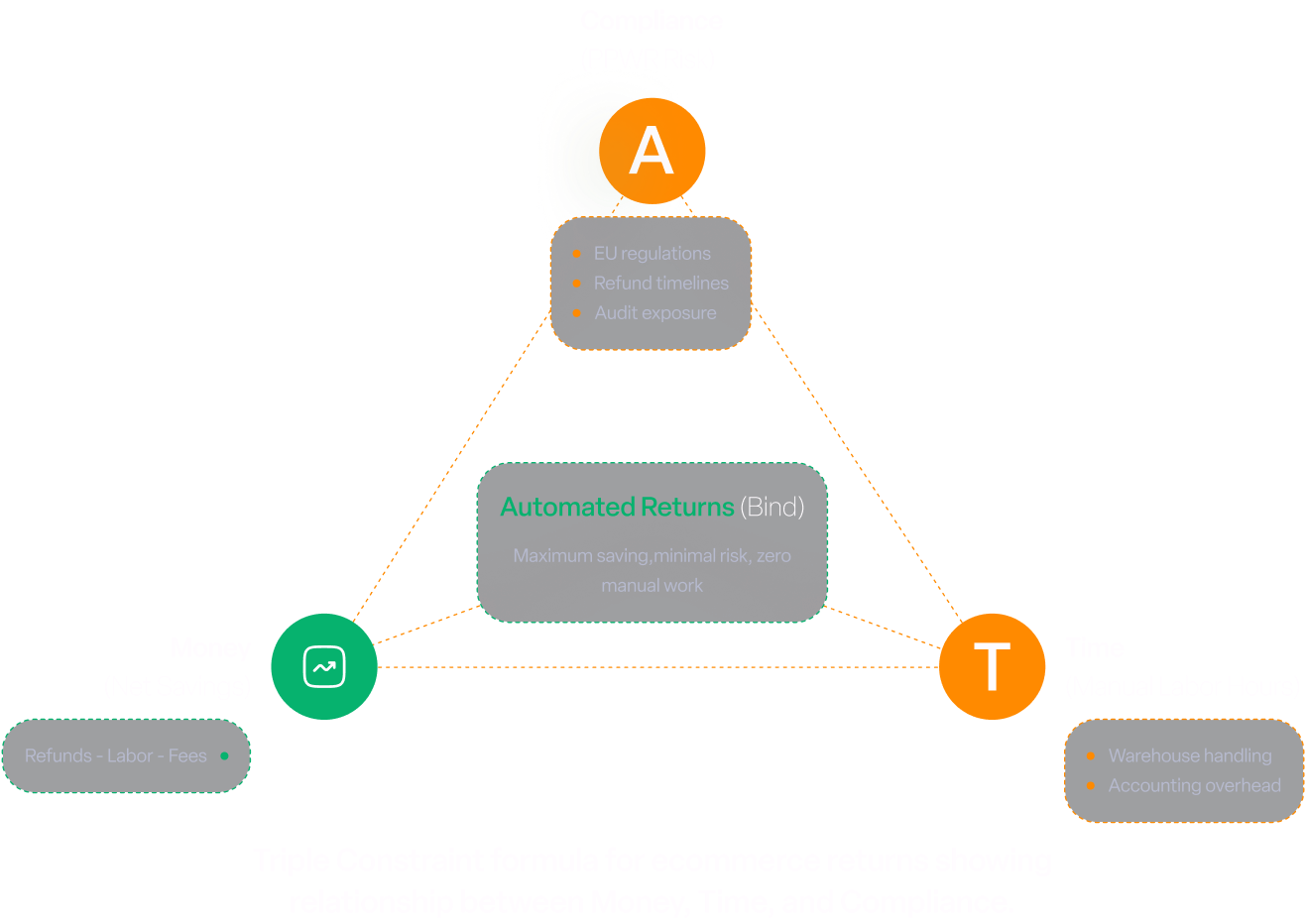
Let’s run a hypothetical scenario for a mid-sized retailer:
- Volume: 1,000 returns/month
- Manual Labor Cost: €10,000/month (based on 333 hours @ €30/hr fully loaded).
- Software Cost: approximately €1,500/month for a premium automation suite.
- Hidden Savings:
-
- Reduced Shipping: AI prevents shipping back 10% of items (damaged/low value) = €500 savings.
- Retention Lift: 12% increase in repeat buyers due to fast refunds.
The Result: You could be saving upwards of €9,000 per month while simultaneously ensuring you aren’t fined under the new PPWR regulations for inefficient packaging.
Stop the Bleeding Before Q2
“Good enough” was good enough for 2024. But in the competitive and regulated landscape of 2026, where customer experience is the primary differentiator and sustainability is the primary law? Manual returns are a liability you can no longer carry.
The August 2026 deadline for the PPWR is approaching fast. If your returns process is still a “black box” of cardboard and emails, you are running out of time to adapt.
Are you heading to the E-commerce Berlin Expo on February 17-18?
This year’s “Back to the Future” conference will be dominated by discussions on Agentic AI and regulatory survival. Don’t let your operations be the anchor slowing down your 2026 growth.
It’s time to stop paying humans to do robot work.